Beijing hotel rooms prices rise 400-1000% for Olympics

BEIJING, March 7 (Xinhua) -- Quoted prices for hotel stays in Beijing during the summer Olympics has jumped up by four to ten times higher than normal, said China's biggest online booking provider Ctrip.com International Ltd.

The travel booking company said on Friday that its online hotel reservation data show that standard hotel rooms in four and five star-ranking hotels during the August Olympics have been nearly booked out.

"Only some 20 hotels in Beijing still have rooms available for reservations by foreign tourists during the period. However, mostly probably, only luxury suites are left for them to choose," said Tang Xiaofeng, senior hotel business development manager of Ctrip.com.

The website provides updated hotel-room reservation information of 500 of Beijing's total 800 star-ranking tourist hotels. Nationwide, it has links with 2,800 hotels.

A receptionist at the Jinlun Hotel, a four-star hotel seated by the side of Beijing's east-west axis Chang'an Avenue said that all of the hotel rooms have been booked out during the Beijing Olympics with the daily price for a standard room quoted at 6,000 yuan (833 U.S. dollars), as compared to 1,008 yuan (140 U.S. dollars) at present.

Tang said that most hotels in Beijing require hotel bookers to pay full price in advance for staying during the event. Hotels would not refund the money if customers changed schedules or cancelled reservations.

He said as hotel rooms in Beijing are getting hotter, many hotels only receive customers who prepare to stay longer than five days in August.

Beijing is gearing up to accommodate about 500,000 foreigners during the Games, along with huge numbers of domestic tourists.

Besides tourist hotels and public lodging houses and inns, Beijing will also provide 1,000 officially designated "Olympic Family Hotels" to accommodate the visitors. The cost of each "Olympic Family Hotel" is 50 to 80 dollars per night.

The Shanghai-based Ctrip.com also found the hotel price in Beijing Olympics' co-host cities, such as Qingdao and Shenyang would rise by 30-40 percent during the event. The east China coast city of Qingdao, which is also a popular beachside resort city in summer, will see price rises of 50-100 percent higher than normal days during the Games.

Read More

"Bird's Nest" for Olympics to be completed in May

BEIJING, March 8 (Xinhua) -- The iconic "Bird's Nest" National Stadium, the main venue for Olympic events, is expected to be completed in May, a Beijing Municipal Construction Committee spokesman said on Saturday.

The National Stadium, or "Bird's Nest" is lit in colors at night and reflected in the water in Beijing, March 3, 2008.Managers of the 91,000-seat arena, which will host the opening and closing ceremonies at the summer Games, began trials on lighting the stadium.
The stadium would undergo tests of its equipment and performance stage for the opening ceremony. Also, lawn areas would be sodded during March. The whole project would be completed in May, said the spokesman.

The Olympic National Park, China National Convention Center, Olympic village and Olympic media village would also be completed in March and April.

These projects are part of Beijing's overall construction plan, which includes 127 projects, 53 to be completed this year, the spokesman said. He didn't give a schedule for the other projects.

All key projects on the list relate to the Olympics or to transportation, environmental protection, residents' livelihood, modern industries and energy resources.

The "Bird's Nest" has the world's most advanced screening and omni-directional systems and mobile seating. It will be used for large sports events, conventional competitions and non-competitive events as well as to provide wide-ranging entertainment and sporting facilities to residents after the Games. The Games are to run from Aug. 8-24.

Read More

Born to run: Ato Boldon

Self-belief comes naturally to Ato Boldon, a four-time Olympic medalist, who says he was born to run, and who will serve as a sports analyst for NBC at the upcoming Beijing Games.

Success builds confidence, of course, and the 34-year-old Trinidad and Tobago (TT) sprinter has had a good run. Starting his sporting life as a soccer player he switched to athletics and competed in his first of four Olympics aged 18, in Barcelona.
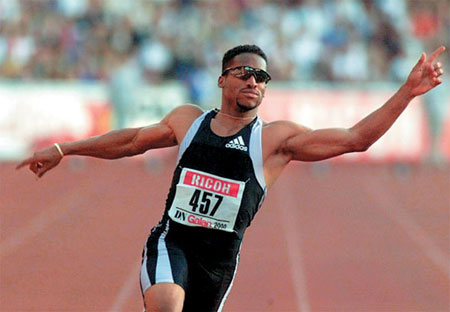

Ato Boldon of Trinidad and Tobago crosses the finish line to win the 100m in 10.01 seconds at the IAAF Athletics Grand Prix meeting in Stockholm, Sweden in this August 1, 2000 file photo. [Agencies]

A world champion in the 200 m, Boldon has only been beaten by his American rival Maurice Greene in terms of sub-10 second 100 m races. His career segued into politics after retiring from the track and he became an opposition senator in 2006, gained a pilot's license and commentated for Britain's BBC, the United States' CBS and NBC.

He has produced and directed a documentary about TT's qualification for the 2006 FIFA World Cup. He also coaches the Saudi Arabian athletics team and is part owner and writer for a leading athletics website.

"I approach everything I undertake as though I were born to do it -- it removes the fear, because as humans we often believe we aren't capable or aren't good enough," he said in an exchange of e-mails from the United States, where he lives.

The self-assured US-based sociology major is quick to offer his views on a range of sport-related subjects.

For instance, though he was accused and cleared in 2001 of using the performance-enhancing drug ephedrine (found in common flu remedies, Boldon had been treating a cold), he is virulently anti-drugs.

"Sport should clean up and Marion (Jones) is the latest and best example of the fact that no matter how high you get, if you get there illegally the skeletons in your closet may still come calling some day."

He can also be diplomatic. Director Stephen Spielberg's recent resignation from the Olympic ceremonies creative team drew a tempered reaction.

"Everyone has their own personal outlook, and I respect that. Lots of countries that will remain nameless have had human rights violations, but somehow the media focuses on the ones they choose to. Sports and politics will always be intrinsically linked because they both evoke such passion in people."

As for China's organization of the Games, Boldon says he's expecting fireworks at the opening ceremony, even without Spielberg.

"(The Chinese) invented them I think they're going to do a fantastic job of hosting and surprise a lot of people. They are perfectionists and they will host the Games as such."

Regarding his new role at the Olympics as a broadcaster, Boldon said he will rely on natural ability, preparation and timing, as befits a top-rate athlete.

"The true art is knowing when to shut up. You can talk through certain things and ruin the moment forever. The best times during a track and field broadcast are when nothing is said, sometimes, like before the gun sounds to start the 100m dash final, or after a huge victory.

"Apart from that, it's about conveying your passion and finding the balance between talking to an audience that knows the sport well and to someone who has never ever seen it."

He says the highlight of the Games will likely be in the pool and on the track. He rates the US track team as the best ever and says he is looking forward to a Jamaica versus US duel in the sprint and relay events.

Pressed for a possible lowlight, he pointed to another potential drug scandal comparable to what happened with disgraced Canadian 100 m runner Ben Johnson at Seoul 1988.

Though Boldon has had his fair share of success, he has also dealt with disaster. A car crash in 2002 practically ended his career as a competitive runner and the fallout over how his case was handled by TT police led him to make some bitter comments about his country.

But Boldon does not regret missing out on Olympic gold, having racked up three bronze and one silver in the 100 m at Sydney 2000. It turns out his favorite sporting memory isn't an individual medal. Instead, it's winning silver in the 100m relay at the 2001 World Championships in Edmonton, Canada.

"It was a very young team that I led and we almost became the best in the world. No one foresaw it except us four and no one could have predicted it."

Asked whether it would be a bittersweet experience commenting on the action rather than being part of it in Beijing, Boldon said he is ready for a new challenge.

"I had my time and I retired when I wanted, at 30. I was on the podium four times, at four Olympics, and even though I never got Olympic gold my life was forever changed by being on that stage and by being able to represent my country."

Read More

Home for athletes, friendly to environment

The Olympic Village will welcome as many as 16,000 athletes and officials during the Beijing Olympic Games, and at the same time it won't consume too much energy to accommodate the guests.

The Beijing Organizing Committee for the Games of the 29th Olympiad (BOCOG) invited the press for a sneak preview of the Olympic Village on Wednesday. During the press conference prior to the visit, Olympic officials said the United Nations Environment Programme (UNEP) praised the village as a healthy, comfortable and energy-saving residential area focusing on people during a visit last year.

Journalists take photos of the gate of the Olympic Village during a press trip organized by Beijing Organizing Committee for the Games of the 29th Olympiad (BOCOG) March 5, 2008 Covering an area of 66 hectares, the village has 42 buildings and will house 16,000 athletes, coaches and officials during the Beijing Olympic Games। The village will be officially opened on July 27 for the Olympics and August 30 for the Paralympics.


Located northwest of the National Stadium, or Bird's Nest and covering an area of 66 hectares, the village consists of 42 buildings with 9,993 rooms in total. It is no more than five minutes' drive from the Nest to the village.

Behind a grand hotel-like gate, the light grey and brown apartment buildings are lined up on both sides of the walkway. It looks like a typical residential area.

However, the design behind this complex is not only high-tech but green too.

Liu Rong, an official from Guo'ao Investment Company, which was contracted to build the Olympic Village, said there were water reclaiming systems, solar energy generators and energy-preserving facilities installed to sustain and save energy within the village.

Liu said the village would save as much as 200 tons of water for landscaping through a biological sewage treatment technique, where recycled water would be used to water grass and plants. This is good news for the water-tight host city.

A red carpet led to an apartment for the press to examine. It was in a six-storey building with two units on each floor. In between the two units are two bins, one for recycling, the other for waste.

Three clay statues of women from the Tang Dynasty stood on the table near the door to welcome guests. Beside them was a living room with photos of old Beijing hanging on the wall.

"We decorated the rooms with Chinese elements taken into account. We will also have booths selling Chinese traditional arts and crafts in the village," said Yu Debing, deputy head in charge of village construction.

Three bedrooms and bathrooms surrounded the living room. Organizers had arranged beds with extra mattresses tacked on for tall athletes like Yao Ming and handle bars in the bathroom for the disabled.

Yu added that parties and performances would be organized to encourage athletes from all countries to participate in the concept of "the people's Olympics". "Athletes compete in the venues, but they are friends in the village. We want to make them feel at home," Yu said.

In addition, double-glazing low-E windows are installed in each unit to prevent from heat from entering the rooms in August. "Future residents after the Games can also benefit from this high-tech widow as they can turn their air-conditioning down a little bit," said Liu. This housing complex is also the first in Beijing to offer potable water for residents.

Salespersons didn't reveal the price of the units which will be sold after the Games. However, they will definitely be hot for grab since so many sports icons will be former residents.


Journalists take photos of the Olympic Village during a press trip organized by Beijing Organizing Committee for the Games of the 29th Olympiad (BOCOG) March 5, 2008

Journalists visit the Olympic Village during a press trip organized by Beijing Organizing Committee for the Games of the 29th Olympiad (BOCOG) March 5, 2008

Two beds with additional mattresses for tall athletes are arranged in a bedroom in the Olympic Village in this photo taken on March 5, 2008 The Organizing Committee for the Games of the 29th Olympiad (BOCOG) unveiled the village to the press on Wednesday. Each unit has three bedrooms which accommodate six athletes.

A model of the Olympic Village is seen here The Organizing Committee for the Games of the 29th Olympiad (BOCOG) unveiled the village to the press on March 5, 2008.

A photographer takes photos of a bathroom in the Olympic Village March 5, 2008 The Organizing Committee for the Games of the 29th Olympiad (BOCOG) unveiled the village to the press on Wednesday. Each unit has three bedrooms which accommodate six athletes.

Journalists take photos of a bathroom with handle bars for the disabled in the Olympic Village during a press trip organized by Beijing Organizing Committee for the Games of the 29th Olympiad (BOCOG) March 5, 2008

Photos of old Beijing are hung in a living room in the Olympic Village in this photo taken on March 5, 2008 The Organizing Committee for the Games of the 29th Olympiad (BOCOG) unveiled the village to the press on Wednesday. Each unit has three bedrooms which accommodate six athletes.

Two bins (one for recycling and the other for waste) stand in the corridor in an apartment building in the Olympic Village on March 5, 2008 The Organizing Committee for the Games of the 29th Olympiad (BOCOG) unveiled the village to the press on Wednesday.

A sign indicating the address of a building in the Olympic Village is seen in this photo taken on March 5, 2008. The Organizing Committee for the Games of the 29th Olympiad (BOCOG) unveiled the village to the press on Wednesday.

A reception building stands in front of an apartment building in the Olympic Village in this photo taken on March 5, 2008. The Organizing Committee for the Games of the 29th Olympiad (BOCOG) unveiled the village to the press on Wednesday. [chinadaily.com.cn]
Read More

China tempers Olympic medal expectations

BEIJING - China's sports authority is lowering medal expectations and offering counseling for athletes as pressure mounts on the hosts to succeed at Olympic Games in August.

Deputy Sports Minister Cui Dalin acknowledged that the Chinese public holds high hopes for the country's athletes to top the medal tallies in Beijing. On Wednesday, he offered a long list of reasons why that likely won't happen.

"We've got to take a pretty sober, objective view toward this। Overall, we're not a big sporting nation," Cui told delegates to China's main government advisory body.

Like China, the US has been downplaying its chances in Beijing, an apparent strategy to reduce pressure on athletes. Historically, however, the host nation has enjoyed a boost in the medal tally.

Although China was second in golds at the 2004 Games in Athens, it was a distant third in the overall medal tally, he pointed out. Chinese athletes are offered powerful inducements for winning performances, from entry into elite universities to lucrative endorsement deals.

In dampening medal expectations, Cui cited challenges ranging from rule changes to limited growth prospects in sports that China already dominates, such as diving, table tennis and badminton. Meanwhile, China has recently fallen further behind top nations in medal-rich sports, such as athletics and swimming, that hold the key to topping the tallies, he said.

China is also weak in three popular balls sports: soccer — "very disappointing," Cui said; basketball — "not so good"; and volleyball — "only the women show much promise."

"In the competition altogether, the United States and Russia are still well above our level," Cui said.

Chinese athletes are under pressure from the public, with invasive media coverage making things worse, Cui said.

Trainers were ramping-up athletes' mental preparations by hiring psychologists to provide counseling, he said, without giving details.

Sports psychology remains largely unknown in China, with most coaches merely telling their athletes to "chi ku," or "eat bitterness."

In one bright spot, Cui said authorities were cheered by news that NBA All Star center Yao Ming was expected to be fit to play for China despite suffering a season-ending foot injury.

Cui laughed, however, when asked to offer a prediction for China's medal haul.

"The beautiful thing about athletic competition is that you never know the result until the competition is over," he said।


Read More

Becker urges Federer to stay in Olympic village

BERLIN - Boris Becker has advised world tennis No 1 Roger Federer to live in the athletes' village at the Olympics in Beijing rather than seek more private quarters away from the Games.

Federer said this week he was unsure whether to stay with his fellow athletes after experiencing difficulties in Athens in 2004. But Becker, a gold medalist in Barcelona in 1992, said he should only consider staying apart as a last resort.

"That was our trick in Barcelona, staying at the Olympic village," Becker, who won gold in the doubles with Michael Stich, said in an interview with Reuters.

"To get into the right frame of mind, to understand what the Olympics is all about, you should try to be as often as you can in the Village, to mingle with the other athletes. I think that gives you a much bigger motivation.

"I'd absolutely recommend that Federer stays there.

"But let's say he should have a bed in the Swiss quarter and maybe if it's really terrible his girlfriend should have a bed ready in a five-star hotel next door. That would be the ideal choice."

Becker won six Grand Slam titles and also helped Germany to two Davis Cup wins but, now 40, he looks back on his Olympic experience with ever greater fondness.

"The older I get the more important it becomes," Becker said. "I was in the team four times and I got hurt three times. The one time in Barcelona in 1992 it was in August, I lost singles early. My only chance was with Michael Stich.

Stick together

"We were not best friends but we realized that if we could stick together we could go all the way. Now looking back it stands out as one of my great victories."

Becker has a career as a TV reporter and commentator and he is now trying his hand at poker, playing on the Pokerstars European tour।

He laughed off media reports this week suggesting he was taking up the game professionally, while playing down the importance of recent reports into gambling in tennis.

"The main thing for me is to have a good time," he said. "I don't have the talent or the time to be a professional poker player. I don't even bet, and I never heard anything about players gambling during my time. There wasn't even doping then!

"I think the story is bigger than the reality. Yes, a couple of players were caught. They weren't in the top 10 or even in the top 20 or 30. Yes it's a story, but I don't think it's going to affect anyone very much."

As for the future, Becker has no plans to return to tennis in any serious way but he is excited about the future.

"I think for a while it was boring," Becker said. "I thought two or three years ago it was a given: Roger Federer was playing and Roger Federer would win.

"He's still a very dominant player and he's still my top pick for Wimbledon, for the US Open, for the No 1 world ranking. I don't think anyone comes close yet.

"But you have younger players who are hungry। He has to work more than he has had to do in the past and that's good."


Read More

Bird's Nest postponed a month

Beijing's National Stadium will not be completed until the end of April after preparations for the Olympic opening and closing ceremonies interrupted construction, a top official from the Beijing Olympic Games organizing committee for the Games of the XXIX Olympiad (BOCOG) told China Daily yesterday.

The National Stadium, or "Bird's Nest", is lit in colors at night in Beijing, March 3, 2008। The Stadium will not be completed until the end of April after preparations for the Olympic opening and closing ceremonies interrupted construction.[Xinhua]

The architectural centerpiece of the Beijing Olympic Games, affectionately known as the "Bird's Nest", was scheduled to be finished by the end of March ahead of two "Good Luck Beijing" Olympic test events in April and May.

"The construction of the venue and the background setting up for the ceremonies are going on together now, which has postponed the working progress of the Bird's Nest," said Jiang Xiaoyu, executive vice-president of BOCOG and a newly-elected CPPCC member.

"The Bird's Nest will be the last but the best venue at the Beijing Games."

Located at the north end of the city's central axis line, the National Stadium, designed by Herzog & DeMeuron (Swiss) and China Architecture Design Institute, will host the opening and closing ceremonies, all athletic events and the men's soccer final.

Village completed

Another important Olympic venue, the Olympic village, has also been largely completed.

"Up to now, the construction of all buildings in the Olympic villages have been completed and a full loading test is scheduled to be carried out before July 8, when the lockdown begins," said Liu Rong, an official from Beijing Guoao Investment Development Co Ltd, the owner of the venue.

The Olympic Village is located at the northwest corner of the Olympic central area in northern Beijing.

It will accommodate 16,000 athletes and officials during the Olympics and 7,000 athletes and officials during the Paralympics.

The village will open to athletes and officials on July 27, two weeks before the opening of the Beijing Games and, afterwards, serve the Paralympics until September 20.

"In order to make it a home for all the athletes and officials, we will hold various recreational activities and performances in the village," said Yu Debin, the village's deputy director। "When the athletes achieve good results, we will present them cards with congratulations."


Read More

Aussie cricketer flattens streaker

Australian bad-boy cricketer Andrew Symonds flattened a streaker during the second one-day final against India in Brisbane.
BEIJING, March 5 (Xinhuanet) -- A surprising but delighting scene occured Tuesday when Australian bad-boy cricketer Andrew Symonds flattened a streaker during the second one-day final against India in Brisbane.

The man ran onto the pitch, naked, and toward Symonds at the non-striker's end on Tuesday as he attempted to evade chasing police and ground security staff at the Australia vs India match.

Symonds stood his ground and leaned into the streaker in a rugby-style shoulder charge, dropping him instantly to the ground.

Symonds, who may face disciplinary action, reached 42 as Australia was beaten by nine runs, losing the series 2-0.

Symonds could face a serious punishment if the International Cricket Council decides that he breached section 4.2 of the player's code of conduct relating to a physical assault of a rival player, an official or a spectator.

The sanction for that is a suspension from five test matches or 10 limited-overs internationals up to a life ban.

Australian bad-boy cricketer Andrew Symonds flattened a streaker during the second one-day final against India in Brisbane. (Source: Xinhuanet.com)
Read More

Bird's Nest lights up for test

The National Stadium, or "Bird's Nest" is lit in colors at night and reflected in the water in Beijing, March 3, 2008.Managers of the 91,000-seat arena, which will host the opening and closing ceremonies at the summer Games, began trials on lighting the stadium। [Xinhua]

The National Stadium, or "Bird's Nest" is lit in colors at night and reflected in the water in Beijing, March 3, 2008.Managers of the 91,000-seat arena, which will host the opening and closing ceremonies at the summer Games, began trials on lighting the stadium। [Xinhua]

The National Stadium, or "Bird's Nest" is lit in colors at night and reflected in the water in Beijing, March 3, 2008.Managers of the 91,000-seat arena, which will host the opening and closing ceremonies at the summer Games, began trials on lighting the stadium। [Xinhua]

The National Stadium, or "Bird's Nest" is lit in colors at night and reflected in the water in Beijing, March 3, 2008.Managers of the 91,000-seat arena, which will host the opening and closing ceremonies at the summer Games, began trials on lighting the stadium। [Xinhua]

This February 6, 2008 file photo shows the National Stadium, also known as the Bird's Nest, is lit in different colours in this combo on the eve of the Lunar New Year in Beijing। Managers of the 91,000-seat arena, which will host the opening and closing ceremonies at the summer Games, began trials on lighting the stadium on March 3, 2008.

China's National Stadium (L), also known as "Bird's Nest," is shown in this file photo as the National Aquatics Centre is lit at night in Beijing, Dec. 4, 2007. Managers of the 91,000-seat arena, which will host the opening and closing ceremonies at the summer Games, began trials on lighting the stadium on March 3, २००८


China's National Stadium, also known as "Bird's Nest," is shown in this Dec. 4, 2007 file photo as the National Aquatics Centre is lit at night in Beijing. Managers of the 91,000-seat arena, which will host the opening and closing ceremonies at the summer Games, began trials on lighting the stadium on March 3, 2008. [Asianewsphoto]
Read More

Wangs get China's Asian qualifier spots for Beijing

China's table tennis veteran Wang Nan answers questions raised by journalists as she arrives in Hong Kong, March 3, 2008। Wang will represent China in the Asian qualifiers for an Olympic berth. Four places in the host's team for the Games have already been taken by Ma Lin, Wang Hao, Zhang Yining and Guo Yue, leaving two spots up for grabs at the Asian Olympic qualifiers, which start on Thursday.

China's table tennis veteran Wang Liqin answers questions raised by journalists as he arrives in Hong Kong, March 3, 2008। Wang will represent China in the Asian qualifiers for an Olympic berth. Four places in the host's team for the Games have already been taken by Ma Lin, Wang Hao, Zhang Yining and Guo Yue, leaving two spots up for grabs at the Asian Olympic qualifiers, which start on Thursday.


China's table tennis veterans Wang Nan (L) and Wang Liqin (R) walk out of the rail station in Hong Kong with men's team coach Liu Guoliang, March 3, 2008. Two Wangs will represent China in the Asian qualifiers for the last two Olympic berths. Four places in the host's team for the Games have already been taken by Ma Lin, Wang Hao, Zhang Yining and Guo Yue, leaving two spots up for grabs at the Asian Olympic qualifiers, which start on Thursday.
Read More

Federer unsure over Olympics village

DUBAI: Roger Federer, who has always said that an Olympic gold medal is one of his biggest goals, has cast doubt on whether he will stay in the Olympic village in August. Federer was a little troubled with his experience in the Athens in 2004 when he lost early on to Tomas Berdych and fears that some of the shortcomings of those Games might be repeated in Beijing.

There the world No 1 from Switzerland felt that four years ago there were several things which made it difficult for him, and he would like to consider avoiding a repeat.

"It was quite difficult in Athens," Federer said. "Taking the bus and not being in control of my own schedule, and many people recognizing me in the village.

"It was not as enjoyable as Sydney, which I loved. I still have not made up my mind (whether to stay in the Olympic village)," he added, perhaps concerned as to whether there would be traffic and commuting problems for visiting athletes.

Asked about the inconvenience of being recognized so much, Federer elaborated by saying: "Every time I go to eat everyone taps on your shoulder. I don't mind it but I wish it was different one day of the week."

Avoiding recognition is also one of the reasons why he makes Dubai his training base, Federer admitted, an arrangement which may help him deal with the rare situation in which he finds himself this week.

The world's best player finds himself playing one of the world's most up-and-coming players, Andy Murray in the first round of the Dubai Open - a situation which could only happen in this very unusual tournament.

That is because the record appearance money gives it an entry similar to the top half of a Master Series, or top quarter of a Grand Slam. But it is a third- level tournament's 32 draw with only eight seeds.

Murray, the world No 12 from Scotland, is therefore likely to be a tougher first test than Federer will get anywhere, especially as he has not competed since being beaten by Novak Djokovic in the semi-finals of the Australian Open more than six weeks ago.

"I am happy to be back playing again because I have been away from the tour and it's not easy. This is only my second tournament in four months.

"But I am back stronger and healthier than I was in Australia. Hopefully this time I will feel better."

This was as close as Federer got to admitting that his performances in Melbourne might have been affected by having been ill, as had been rumored, though when asked about this directly he deflected it.

"I just felt slow in the semi-final," he said. "I really doubt that it was because of the Tipsarevic match (a hard five sets) because I was feeling like that against Berdych.

"By the Djokovic match I was completely fine again. I just wasn't happy with my movement and defensive skills. Maybe it (losing) was because of that. Djokovic played well on the big points."

Read More

Italian Olympic Athletes to Use Ferrari-Designed Equipment


Successes at Ferrari had prompted the Italian Olympic Committee to seek a fast partnership with the Maranello-based company. The agreement would see CONI, the Italian Olympic Committee, pair up with Luca di Montezemolo’s outfit in producing better, faster, stronger athletes for the next two Olympics.

Ferrari would essentially help develop hi-tech equipment for such disciplines as skeleton, canoeing, sailing, paralympic skiing, bobsled and luge.

"We want to be as fast as a Ferrari in Beijing," CONI president Giovanni Petrucci said.

Di Montezemolo echoed his sentiments: "There are three things we have in common: passion, the ability to work as a team and the Italian flag," he said. "If there is even one-thousandth of Ferrari in Italian victories, we'll be honored."

If this works out for both entities we may see the likes of McLaren, Renault and RBR teaming up with their own Olympic committees seeking wins. What’s uncertain is if a losing F1 team would automatically bring down its associated Olympic team.

Source: Associated Press via ESPN


Related entries:

Volkswagen - Partner of Beijing 2008 Olympic Games
Volkswagen unveils first convoy-vehicles for Olympic torch relay


Read More

Diving officials rule out need to raise difficulty

Many foreign divers have been showing the highest levels of difficulty in their dives in recent competitions. But Chinese diving officials insist they don't need to increase the degrees of difficulty to ensure their team's success and need only to improve the precision of their current dives.
Chinese diver Zhou Luxin reacts after finishing second in the men's 10m platform at the16th FINA Diving World Cup in Beijing on February 24. Inset: German Sascha Klein celebrates with a teammate after beating Zhou to win the men's 10m platform gold medal. [China Daily]


"The Chinese team won't try to practice for higher difficulty degrees, but to strengthen the quality and stability of the dives," said Zhou Jihong, leader of China's national diving team.

"Some of the foreign divers are striving for highest difficulty levels. There will be no weak divers at the Olympic Games."

At the FINA Diving World Cup last month, the highest difficulty degree - and highest score - in the men's 3m springboard came from 21-year-old Yahel Castillo of Mexico, who was only 0.30 points behind China's world champion Qin Kai to take the bronze.

His 3.9 dive - the most difficult dive attempted up to that point - claimed the highest score of 105.30 and lifted him to third place.

His compatriot Paola Espinosa was the only one in the women's 10m platform to use two dives with the current highest difficulty level of 3.4. She claimed bronze at the event, after China's Chen Ruolin and Wang Xin.

In the men's 10m platform, which is considered a weak point of the Chinese team, Sascha Klein from Germany grabbed the gold with the highest total degree of difficulty. It was the only gold medal that China missed at the World Cup, which also served an important Olympic qualifier.

"At the semifinal of the men's 10m platform at the Grand Prix, one diver from the US even tried a dive with a difficulty degree of 4.1. Although he didn't quite pull it off, we can see that some of the foreign divers are planning to clinch the gold with high difficulty," Zhou said.

The top eight divers in the finals won qualification for the Beijing Games. Each national federation can submit its final list of divers before the June 23 deadline.

For the Chinese team, which is considered as the "diving dream team", the lineup for the Games won't be decided before then.

"The lineup of the World Cup is not the same one we'll send to the Beijing Olympic Games since our team will still attend many FINA competitions up until June," said team leader Zhou. "The lineup of the Beijing Olympic Games still needs some months to decide We will choose the best divers in their best form."

Of all the team members, "Diving Queen" Guo Jingjing has most likely booked her spot in women's springboard.

Her partner in the 3m synchronized event, Wu Minxia, who beat Guo in the individual event to win the title at the World Cup, has a great chance for another spot, although young diver He Zi emerged to win silver at the Grand Prix.

As for other Athens Olympic champions Hu Jia and Peng Bo, who were absent from the World Cup, Zhou said: "They had injuries in the past two years and took a rest for some time. Now they are still recovering. Whether or not they can enter the Olympics will be decided by their performances in the coming months."

Despite winning seven out of the eight gold medals at the World Cup and sweeping all the golds at the 14th FINA Diving Grand Prix last weekend in Shenzhen, Zhou said it was too early to get excited.

"There were still some world class divers who did not come," she said. "In the men's 3m springboard and 10m platform, Russia didn't send any divers. We just take it as a training session.

"Competing in two important events, one immediately after another, has required a lot of their physical and psychological conditions. How to adjust themselves to the best forms for different competitions should be what they have learned."


Read More

Director confident of opening success

Film director Zhang Yimou said yesterday he was very confident of a successful opening ceremony for the Beijing Olympics in August. "The mass rehearsals for the opening ceremony of the Beijing Olympic Games, with more than 10,000 people involved, are going well," Zhang said before attending the First Session of the 11th National Committee of the Chinese People's Political Consultative Conference (CPPCC), which started yesterday in the capital.
Film director Zhang Yimou, who is also director of the opening and closing ceremonies for the Beijing Olympic Games and a member of the First Session of the 11th National Committee of the Chinese People's Political Consultative Conference, is encircled by reporters yesterday in front of the Great Hall of the People. [China Daily]

Zhang has been tasked with designing the opening and closing ceremonies for the Games.

He said he felt "regret" over Hollywood director Steven Spielberg's recent withdrawal from the Olympics as its artistic advisor.

But Spielberg's decision will not have any influence on the ceremonies, Zhang said.

The American movie director was appointed artistic advisor by the Beijing Organizing Committee for the 2008 Olympics in April 2006, and became involved with the opening and closing ceremonies of the event, together with Zhang and Ric Rirch, the Australian director behind ceremonies at the Sydney Games in 2000.

Spielberg quit last month, citing concerns over the humanitarian crisis in Darfur, which he linked to the Chinese government.

"The Olympics shouldn't be used to solve problems that have nothing to do with the event. On the contrary, it is supposed to shun such problems," Yang Lan, a CPPCC member, said on Sunday.

Athletes will be the victims if the event is politicized, the 40-year-old TV anchorwoman said.

What the Olympics should care about is allowing athletes to compete well and fully enjoy the fun of sports, and let people of different nations experience peaceful and friendly exchanges, Yang said.

"If the Olympics are politicized, the athletes will be hurt most," Yang, one of the ambassadors for Beijing's Olympic bid, said.

She cited the example of how athletes of some countries missed out on the Olympics due to the Cold War in the 1980s - both the 1980 Moscow Games and 1984 Los Angeles Olympics were affected by boycotts.

"Those athletes were innocent."

Yang said the former president of the International Olympic Committee (IOC), Juan Antonio Samaranch, had told her during an interview he was resolutely opposed to politicizing the Games. The Olympic Charter outlaws political acts, she said.

"No kind of demonstration or political, religious or racial propaganda is permitted in any Olympic sites, venues or other areas," the 51st section of the charter reads.

Meanwhile, more than 60 State and government leaders across the world have made plans to attend the Beijing Olympics.

In an interview with the BBC in mid-February, US President George W. Bush said he had no reason to use the Olympics as a way to highlight political issues, because he did it "all the time" with the Chinese leadership.

"I'm going to the Olympics. I view the Olympics as a sporting event," he said.

Read More

Olympic-themed lottery to be issued for trial sales

BEIJING -- China is to issue an Olympic-themed lottery for trial sales in four provinces later this month, with price set between five and ten yuan, said a local daily newspaper Sunday.

The instant lottery consists of five varieties, featuring different themes such as " To be the No. 1" and "Good luck to China". They will be issued firstly in Hebei, Jiangsu, Zhejiang and Shandong provinces, the Beijing News quoted sources with China's Sports Lottery Administration Center as saying.

The designs on the lottery contain the Fuwas, the five Beijing Olympic mascots, Olympic game introductions and also the Olympic torch relaying route, among others.

Different from other instant lotteries, the Olympic lottery will have a 65 percent prize-winning rate, with the top prize standing at 250,000 yuan (about $34,965).

Online operation will ensure the lottery selling open and fair, according to the sources.

Beijing will issue the lottery later. Detailed information on lottery sales will be released at the end of March, according to the Sports Lottery Administration Center.

In 2007, China's total lottery sales exceeded 100 billion yuan (some $14 billion), an increase of 18 billion yuan or 20 percent over 2006, setting a 20-year record in China's lottery history.

China launched its first lottery in June 1987. Lottery ticket sales are one of the major sources of funds for building community sports facilities and financing the country's social welfare programs and stipulates that a minimum of 35 percent of takings must go to the welfare sector.

Read More

Yao expects to be ready for Beijing Games, says agent

BEIJING - China's All-Star center Yao Ming believes he will be fit for the Beijing Olympics despite facing an operation on a fractured foot, his Chinese agent said on Sunday.

Yao is expected to need three or four months' rest after an operation which China's state broadcaster said he would undergo in Houston on Monday. That would leave around two months to prepare for the Games which open on August 8.

"He (Yao) believes those two months are enough time to recover," his agent Zhang Mingji said in an interview with the Beijing News.

"I believe that by the Olympics, Yao Ming will have recovered 100 percent," Zhang added.

China's Olympic basketball medal hopes are pinned on Yao, who had averaged 22 points and 10.8 rebounds for the Houston Rockets before his NBA season was cut short.

Zhang dismissed suggestions that Yao's injury was a result of playing too many matches.

"His bone fracture is not because he was played too much, it's a problem that arose because of the structure of his foot," Zhang said, explaining that Yao had high arches.

The 27-year-old is China's most popular sportsman and is a leading candidate to fulfil the prestigious role of lighting the cauldron at the Games' opening.

Read More