Liu and Powell work toward Beijing golds

China's world recordholding hurdler Liu Xiang and Jamaica's Asafa Powell, the world 100- meter sprint record holder, meet for the first time at the opening ceremony of the six-day Amway All-Star Expo at the Shanghai New International Expo Center on Friday. The flying duo said Friday that they will start intensive training soon for the 2008 Beijing Olympic Games and are both confident of their chances. The Shanghai-native Liu was the first Asian to win gold in an Olympic sprint event.


BEIJING, Dec. 8 -- World record hurler Liu Xiang and 100 meters sprinter Asafa Powell are confident of picking up gold medals in their respective events at next year's Olympic Games in Beijing.

"We like each other very much and I think Powell is the greatest 100-meter sprinter in the world," Liu said yesterday. "I expect him to win every race because of his determination and his single-minded purpose as he speeds towards the line. This is the most important mindset for any athlete in a competition."

Powell said he liked Liu and enjoyed his sense of humor.

"I will have to train intensively from now on .... in fact I have already begun my preparations for the Games," the Jamaican said. "I will come to Beijing ahead of time next year to adapt to the climate."

Liu too said he was getting ready with his preparations.

"I will go to Beijing next week to begin my intensive training and I think we are both confident of winning medals," said Liu, who carries China's hopes for an athletic gold at the Olympics.

Shanghai-born Liu is the first Chinese to win a gold medal in an Olympic sprinting event. He clocked 12.91 seconds in the 110-meter hurdles at the Athens Olympics before smashing a world record 12.88 at the Super Grand Prix in Lausanne, Switzerland, in 2006.

The track stars were in Shanghai for a promotion and to shoot for a TV commercial.


China's Liu Xiang (R), 110 metres hurdles world record holder talks with Jamaica's Asafa Powell, men's 100 metres world record holder during a commercial event in Shanghai Dec. 7, 2007.

China's Liu Xiang (R), 110 metres hurdles world record holder, and Jamaica's Asafa Powell, men's 100 metres world record holder, pose during a commercial event in Shanghai Dec. 7, 2007.
Read More

Russia takes group title at rhythmic gymnastics Olympic trial

Olga Kapranova of Russia waves on the awarding podium after winning the final of the individual All-Around at the Good Luck Beijing 2007 Rhythmic Gymnastics International Invitational Tournament held in Beijing, China, Dec. 7, 2007. Kapranova claimed the title with 73.825 points.

BEIJING, Dec. 7 (Xinhua) -- As expected, Russia, the world and Olympic champions, was competing in its own level to reach the top of podium at the rhythmic gymnastics Olympic trial here on Friday.

Russia scored a total of 35.075 points out two apparatus -- five ropes, three hoops and two clubs, atop both of them in 17.500 and 17.575 points apiece.

Italy, the World Cup champions, got improved upon the qualifications by 0.6 to make a second place of 34.600 points, but still not enough to challenge the rhythmic powerhouse Russia.

The crowded spectators got something to celebrate the night as China took up the last place in podium with 34.050. China was ranked only fifth in preliminaries.


Gold medalist, Olga Kapranova (C) of Russia, silver medalist, Anna Bessonova (L) of Ukraine and bronze medalist, Aliya Garayeva of Azerbaijan wave to audience on the awarding podium of the individual All-Around at the Good Luck Beijing 2007 Rhythmic Gymnastics International Invitational Tournament held in Beijing, China, Dec. 7, 2007. Kapranova claimed the title with 73.825 points.
Aliya Garayeva of Azerbaijan competes in the final of the individual All-Around at the Good Luck Beijing 2007 Rhythmic Gymnastics International Invitational Tournament held in Beijing, China, Dec. 7, 2007. Garayeva took the third place with 69.775 points.
Ding Yidan of China competes in the final of the individual All-Around at the Good Luck Beijing 2007 Rhythmic Gymnastics International Invitational Tournament held in Beijing, China, Dec. 7, 2007. Ding took the tenth place with 62.925 points.
Anna Bessonova of Ukraine competes in the final of the individual All-Around at the Good Luck Beijing 2007 Rhythmic Gymnastics International Invitational Tournament held in Beijing, China, Dec. 7, 2007. Bessonova took the runner-up with 70.250 points.
Stela Sultanova of Bulgaria competes in the final of the individual All-Around at the Good Luck Beijing 2007 Rhythmic Gymnastics International Invitational Tournament held in Beijing, China, Dec. 7, 2007. Sultanova took the ninth place with 63.375 points.
Ding Yidan of China perfroms in the final of the individual All-Around at the Good Luck Beijing 2007 Rhythmic Gymnastics International Invitational Tournament held in Beijing, China, Dec. 7, 2007. Ding took the tenth place with 62.925 points.
Olga Kapranova of Russia competes in the final of the individual All-Around at the Good Luck Beijing 2007 Rhythmic Gymnastics International Invitational Tournament held in Beijing, China, Dec. 7, 2007. Kapranova claimed the title with 73.825 points.
Almudena Cid of Spain competes in the final of the individual All-Around at the Good Luck Beijing 2007 Rhythmic Gymnastics International Invitational Tournament held in Beijing, China, Dec. 7, 2007. Almudena Cid took the sixth place with 65.400 points.
Lyubog Cherkashina of Belarus competes in the final of the individual All-Around at the Good Luck Beijing 2007 Rhythmic Gymnastics International Invitational Tournament held in Beijing, China, Dec. 7, 2007. Cherkashina took the fifth place with 66.875 points.
Aliya Garayeva of Azerbaijan competes in the final of the individual All-Around at the Good Luck Beijing 2007 Rhythmic Gymnastics International Invitational Tournament held in Beijing, China, Dec. 7, 2007. Garayeva took the third place with 69.775 points.
Anna Bessonova of Ukraine waves on the awarding podium of the individual All-Around at the Good Luck Beijing 2007 Rhythmic Gymnastics International Invitational Tournament held in Beijing, China, Dec. 7, 2007. Bessonova took the runner-up with 70.250 points.
Aliya Garayeva of Azerbaijan waves on the awarding podium of the individual All-Around at the Good Luck Beijing 2007 Rhythmic Gymnastics International Invitational Tournament held in Beijing, China, Dec. 7, 2007. Garayeva took the third place with 69.775 points.
Read More

Chinese shooters continue gold spree with record breaking shows

Chinese shooter Xu Kun grabbed the gold of men's 50-meter pistol at the 11th Asian Shooting Championships here on Thursday with 662.3 points.


KUWAIT CITY, Dec. 6 (Xinhua) -- After a warming-up on Wednesday when China wrapped up all the four gold medals, Chinese sharpshooters continued sweeping the shooting ranges here on Thursday with their record breaking and equaling shows to bag nine of the ten golds.

Markswomen grabbed the gold of 10-meter air rifle team event with a record-smashing 1,196 points, two points ahead of the previous world record set by Chinese team as well in the 2002 Busan Asian Games.

The team was composed of Olympic gold medalist, world record holder of women's 10-meter air rifle Du Li, champion of the World Cup Bangkok and Guangzhou forts Zhao Yinghui and gold medalist of the 50-meter rifle three positions at the 2005 World Cup Finals WuLiuxi.

Du and Zhao both scored 399 points in the qualification round and Wu collected 398.

In the ten-shot final, the 25-year-old Du, who is ranked world No. 1 of the discipline, stunned the audiences by hitting the bulls eyes with all of the first nine shots above 10 points, including six above 10.6.

Although, after a failure of the electronic screen which begot a small fuss, she finished her performance with a 9.3 point, her 1st position seemed unshakable.

Du said she was regretful at the result.

"I thought I was going to break the world record and suddenly felt nervous," said Du with low voice as her head drooped, "I had been aiming too long before making the shot."

The girl from east China's Shandong Province, who created the world record at the 2003 Croatia World Cup with a staggering 104.9points, was always the last of the eight finalists to open fire.

In the last shot, she needed only a 10.6 point, a score seemed easy to her, to renew the record.

Du's teammate Zhang Yi might have renewed the world record as well, had the record still been renewable.

Zhang, 21, who carved out in the 2006 World Championships by pocketing junior gold of women's 10-meter air rifle, equaled junior world record with 400 points, or the full points, in the qualification round.

The junior record, set by South Korean shooter Seo Sun Hwa in World Cup Sydney Fort, was the same as the world record shared by Chinese markswomen Du Li, Zhao Yinghui and Wu Liuxi together with some others from South Korea, Australia, Germany, Russia and India.

Chinese teenage shooter Li Peijing clinched a silver with 497.8points.

In men's events, Xu Kun added another gold of men's 50-meter pistol with 662.3 points, and teenage shooters Yan Hang and Mai Jiajie split gold and silver in the junior competition of the event.

Thanks to their performances, all five team golds were pocketed by Chinese team.

The only gold medal Chinese lost today was the one for women's trap, in which China's Chen Li, champion of the Doha Asian Games last year, marched into the final with a leading 65 hits, but yielded to Kazakhstan markswoman Elena Struchaeva to finish the sixth.

Good or bad, the scores "only belonged to a single event," said Wang Yifu, head coach of the Chinese national shooting team, "they should maintain the sharpness in the following competitions."


Chinese shooter Xu Kun grabbed the gold of men's 50-meter pistol at the 11th Asian Shooting Championships here on Thursday with 662.3 points
Chinese sharpshooter Du Li, who held the world record of women's 10-meter air rifle, mounted the champion platform of the event again at the 11th Asian Shooting Championships here on Thursday, with an easy win of 503.7
Read More

Who decides the price of a stock?

The prices you see scrolling by on the bottom of the screen on CNBC are records of actual trades between a willing buyer and a willing seller. Each trade is recorded, beamed electronically to millions brokerage houses, Web sites and other sources of stock quotes, and becomes a benchmark – the “market price” - for the next trade. In the end, it’s just one big auction. Kind of like eBay, but a lot faster.

It all starts when Bill Buyer in Boise and Sadie Seller in Savannah call up their broker (or go online) and place a trade. Bill says: “I want to buy 100 shares of Global Nanotech.” At roughly the same time, Sadie places an order to sell 100 of her shares.

Most orders (buy and sell) are placed “at the market” – which means “I want to buy or sell now, just get me the best price you can.” All these orders are routed through a series of brokers, dealers, and computers and, in the case of the New York Stock Exchange, end up at a physical trading post, where thousands of other orders are flooding in at the same time. As they come in, these buy and sell orders are matched up, by computers and/or human beings, based on the price of the last trade recorded for that stock (the “market price.”)

An order to buy 1,000 shares may end up being filled with 10 orders to sell 100 each; if the market is moving quickly, the sellers of those 100-share lots may not get exactly the same price. The matching process involves a running list (an “order book”) of buy and sells requests which are paired off as prices match up and the trade is “cleared.”

Things get a little more complicated if you want to add conditions to your trade — like demanding a specific price। Some buyers and sellers will use what’s called a ‘limit order’ — “I won’t sell unless I get $50 a share” – in which case the trade can’t go through unless a buyer is found who is willing to pay that price. Sellers can also place what’s called a “stop loss” order — “If the stock falls below $50 a share, sell it.”

If the price a buyer is willing to pay (the “bid” price) is higher than the price a seller is willing to offer (the “ask” price), there’s a “spread.” In our case, Bill is willing to pay $52 and Sadie is asking for $50. When that happens, the dealer or market maker matching the trades sometimes pockets the difference. If the spread goes the other way — Sadie wants $52 for her shares and Bill is only willing to pay $50 — in theory the trade won’t go through. On the New York Stock Exchange, the people matching trades (called specialists) are supposed to dip into their own pocket, if necessary, to match trades and keep the market moving.

If Sadie wants $52 and she's the only seller, however, and Bill has placed a market order, then $52 becomes the market price and that’s what Bill pays. And if there are a lot more buyers than sellers at that moment, that higher price — the new “market price” — may bring more sellers into the market, providing plenty of orders on both sides at that price, where it will settle for awhile. But if there are more still buyers than sellers at $52, the price will likely go to $55. At some point, the price reaches a point where the number of buyers and sellers are roughly in balance. (The same scenario works on the way down with more sellers than buyers.)

But if trading gets too lopsided — everyone wants to sell and no one wants to buy — the exchange may stop trading for what’s called an “order imbalance,” which is usually caused by a piece of very good or bad news about the stock — or even a rumor being passed around by traders. After everyone’s had a chance to digest the news, trading starts up again at a different price and (usually) things go smoothly again.

Once a trade is made, it’s then recorded and the price is sent around the world as the next “stock quote” (and the number of shares added to the “volume” number for that stock.) Bill and Sadie get confirmation notices showing the price they got for their trade (minus the broker’s commission.) Electronic bits are then moved from Sadie’s brokerage account to Bill’s. (Physical stock certificates – or other pieces of paper representing financial securities — rarely change hands these days.)

The result is a steady stream of millions of shares traded that reflect the price buyers and sellers are getting for their shares. Unless you’re a day trader, the mechanics of each trade — and the small, minute-to-minute price moves that result — don’t much matter. But no one person or group sets the price. We all do.

Read More

How do you buy a share of stock?

The stock market's steady gains lately have a lot of readers who are new to investing wondering how to get started. Maggie in Florida wants to know how to go about buying a few shares. And Rob is wondering: Just who decides how much you pay for stock when you buy it?

Do I have to use a broker to start investing in the stock market? I'm an average person interested in buying some stock to have just another means of income for retirement. I don't have a vast amount of money to invest. I'm just beginning.
-- Maggie, Jacksonville, Fla.

There’s no rule that says you have to use a broker — just the way you’re free to buy or sell a house without listing it with an agent. But much like any market, the price you get — as a buyer or seller — is usually better if you’re looking at the same prices that every other buyer and seller is looking at.

You also have the benefit of seeing the minute-by-minute prices that other buyers and sellers are paying. The two primary American stock markets — the New York Stock Exchange and the NASDAQ — are basically gigantic auctions with millions of buyers and sellers trading billions of shares a day. So you’ll probably get a better price there than you will on Craigslist or eBay.

Some companies will sell you their stock directly and let you reinvest the dividends in new shares or buy more with cash। You’ll save on the broker’s commission, but you’ll have to deal with one company at a time. And redeeming shares (selling them back to the company) usually involves more paperwork than placing a trade with a broker.

To get started with a broker, you’ll have to open an account with a brokerage firm, which means signing an agreement with detailed terms governing how your transactions will be handled, among other things. Read this agreement carefully, line by line. If there’s something you don’t understand, call up and ask. Don’t sign until you understand why every clause is there. You’ll learn a lot about investing by understanding the agreement; some terms are written for your benefit, some are written to benefit the broker.

When it comes time to actually place the trade, however, you don’t necessarily have to deal with a human being. Many discount brokerages will let you trade online by yourself, where your orders are routed along with those placed by human brokers.

As a beginner, you’ll want to start slowly. Stocks don’t guarantee an income for retirement — in fact, they are a fairly risky way to get started. So you may want to start with a mutual fund or a stock index fund (which tracks the overall performance of an index like the S&P 500.)

You can always ask the broker for ideas about which stocks to buy, but remember that the broker makes money whether the stock goes up or down. Many of the so-called “experts” who recommend stocks on TV or in the newspaper may already own the stock they're so enthusiastic about; if they can convince more people to buy that stock, it could help the price go up — and help themsleves make money. The hardest part about any kind of financial advice is knowing whether the advice is being given for the benefit of the advisor or the client.

If you decide to pick your own stocks or mutual funds, research every one thoroughly – just as you would if you were buying a car or a flat screen TV. Advice from your sister-in-law is fine. But understand what you’re buying and why you’re buying it. And start thinking about when you’re going to sell as soon as you buy.

Is Oneshare.com a legitimate business for me to purchase stocks from?
-- V. M., Bloomington, Minn.

We haven’t dealt with the company, but have no reason to doubt they deliver what they say they will. But it’s an expensive way to buy stock.

We recently went to their site and priced a share of General Electric, which closed at about $38 a share on Friday, Jan. 12 . If you bought a share from Oneshare.com, you’d pay $38 for the stock, plus a transfer fee of $39. Then add $10 shipping and handling -- for $87.

If you bought the stock through a discount broker, you’d probably pay a commission of, say, $20 a trade. (Same for 1 share or 100, so if you bought a typical 100-share lot, the cost would be 20 cents to trade a single share.) Cost per share: $38.20.

On the other hand, Oneshare.com is selling the idea of stock certificates as a wall decoration, suitable for framing. But you can just as easily do this through a broker: just set up an account, buy the stock and then ask to have them send you a physical certificate. You’ll need to pay a transfer fee (one brokerage we called charges $15) and pay shipping (say, $5 via US Mail.) That brings you to $38 + $.20 (commission) + $15 (transfer fee) + $5 (postage) = $58.20.

Read More

One year out would not hurt Alonso, says Coulthard

McLaren's Fernando Alonso of Spain celebrates on the podium after finishing third in the Brazilian Grand Prix at the Interlagos racetrack in Sao Paulo Oct. 21, 2007.


BEIJING, Dec.4 -- Double world champion Fernando Alonso could take a year out of Formula One in 2008 and still come back as a title contender, Red Bull's David Coulthard said on Monday.

"I don't think it would be a problem for him to take a year out," the Briton told reporters at a presentation for the December 16 'Race of Champions' at Wembley Stadium, where the turf has been replaced by an asphalt circuit.

"(France's Alain) Prost was the last guy to do that, he took a year out and came back and won the world championship," added the Scot.

"If you can get yourself into one of the best two cars, then of course you've got a great chance of winning the championship."

Spaniard Alonso, beaten into third place by 22-year-old rookie team mate Lewis Hamilton in the championship, split with McLaren after a controversial and acrimonious season that ended in October.

He has yet to be confirmed elsewhere, despite rumours linking him to Renault, Red Bull, Honda and Toyota.

His former team Renault remain the most likely bet but Alonso may be waiting until after an FIA hearing on Thursday into allegations that they had McLaren technical information in their possession.

Similar allegations by Ferrari against McLaren cost the latter team a 100 million dollars fine in September and the loss of all their constructors' points.

Spanish newspapers have reported that Alonso wants a one-year deal to allow a possible move to Ferrari in 2009 while interested teams are demanding he signs up for at least two seasons.

McLaren's Formula One driver Fernando Alonso of Spain waves to a crowd from a balcony in Oviedo, northern Spain, Oct. 28, 2007.


Coulthard doubted Alonso would end up at Red Bull, who finished fifth overall this year and have yet to win a race. He absolutely ruled out the Spaniard replacing him.

"Why would Fernando leave McLaren to come to Red Bull at the moment?," he asked.

"If he didn't enjoy not winning a lot at McLaren, he definitely isn't going to enjoy not winning at all at Red Bull at the moment is he?"

Champions Ferrari and McLaren won all the races this year and Coulthard doubted whether Alonso would find anywhere as competitive.

Red Bull were on average a second and a half slower than the fastest cars this year and Coulthard said they had set themselves a target of finishing fourth overall in 2008.

"It's going to be quite difficult to get a car that he can win more races in (than at McLaren)," said the Scot of Alonso's predicament. "It is a slightly strange strategy and way to manage your career."

The 36-year-old said his own contract at Red Bull was water-tight, in any case.

"They simply cannot not put me in the car next year, even if they wanted not to, unless there was a solution found," he said.

"Having been around the block a few times, my contract specifically states that if there's a world championship, they (Red Bull) have to enter me in it."

(Source: China Daily)


McLaren's Formula One driver Fernando Alonso of Spain gestures to a crowd from a balcony in Oviedo, northern Spain, Oct. 28, 2007.
Read More

Kaka wins Golden Ball award

AC Milan's Brazilian midfielder Kaka won the prestigious Ballon d'Or award on Sunday.


Read More

China finishes with nine gold medals

The 2007 Gymnastics and Trampoline International Invitational Tournament concluded in Beijing yesterday, with the host winning two more gymnastics gold medals and snagging one gold in men's trampoline.


Cheng Fei of China competes to win the Artistic Gymnastics Women's Beam final at the International Invitational tournament held at the newly-built National Indoor Stadium in Beijing December 3, 2007. [Xinhua]

China's Liang Mingsheng and Feng Zhe grabbed gold and silver medals, respectively, on men's parallel bars, with Yang Taeyoung from South Korea finishing third.

World champion Cheng Fei won a gold medal in women's beam to conclude the competitions. It was Cheng's third gold of the six-day event and China's ninth. Lauren Mitchell from Australia and Chellsie Memmel from the US settled for silver and bronze in beam, respectively.

Even though she won a gold on the beam, which is not considered Cheng's best event, the new Chinese captain was not fully satisfied with her performance.

"Although I made few mistakes today, there were still some small problems in my routine," said the 19-year-old Cheng. "I got the gold today, but I still believe my advantages are in floor exercise and vault."

Cheng won gold medals in those events on Sunday.

Kim Ji-hoon from South Korea won gold in men's horizontal bar, followed by Yosuke Hoshi and Kazuhto Tanaka from Japan. Germany's 2007 world champion, Fabian Hambuechen, finished a disappointing seventh place after he lost his grip at the end of the routine and crashed to the ground.

"It was slippery," Hambuechen explained afterwards. "I had wanted to do a double twist, but I didn't land well."

With four golds, China's Lu Bin was the biggest winner of the tournament, taking first in men's rings, vault, pommel horse and men's team. China's Jiang Yuyuan also won the women's all-around.

In the men's trampoline final, the last event of the two tournaments, China's reigning world champion Ye Shuai clinched the gold with 40.40 points.

Read More

Olympic test Games in Beijing

Ye Shuai of China competes in men's trampoline during the 2007 Good Luck Beijing Olympic test games at the National Indoor Stadium in Beijing on December 3, 2007. Ye won the gold.
China's Cheng Fei competes in women's balance beam during the 2007 Good Luck Beijing Olympic test games at the National Indoor Stadium in Beijing on December 3, 2007. Cheng won the title.
Read More

Nicolas Sarkozy will attend the '08 Games


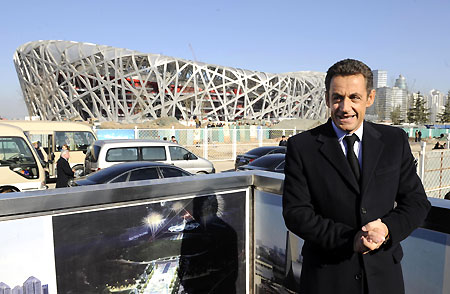
France's President Nicolas Sarkozy visits China's National Stadium during his last day of visit in China November 27, 2007. Sarkozy said he had accepted an invitation by China's President Hu Jintao to come to the Olympic Games in Beijing next August.


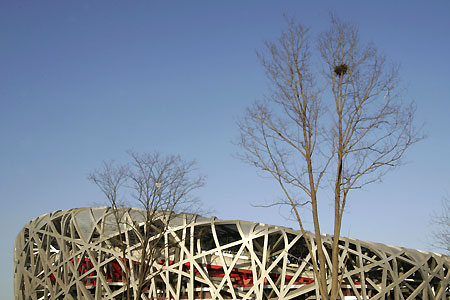
A bird's nest is seen on a tree near&<60;China's National Stadium, also known as the 'Bird's Nest', in Beijing, November 27, 2007.


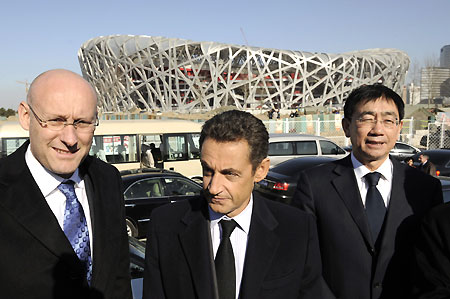
French President Nicolas Sarkozy (C) visits&<60;China's&<60;National Stadium with French Junior Minister for Sports Bernard Laporte (L) during the last day of his visit to China November 27, 2007. Sarkozy said he had accepted an invitation by China's President Hu Jintao to come to the Olympic Games in Beijing next August.

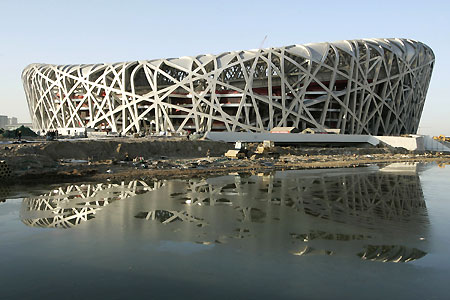
The National Olympic Stadium, also known as the 'Bird's Nest', is reflected in&<60;water>
Read More

United States takes 3-0 lead in Davis Cup final


Mike Bryan from U.S. celebrates his victory over Russia during their Davis Cup tennis finals in Portland, Oregon, Dec. 1, 2007

WASHINGTON, Dec. 1 (Xinhua) -- Hosts the United States snatched their 32nd Davis Cup title, the first in 12 years, when their doubles due Bob and Mike Bryan sealed the victory for their country with a 3-0 lead over defending champions Russia in the best-of-five final on Saturday in Portland, Oregon.

World No. 1 pair the Bryan twins subdued their rivals Nikolay Davydenko and Igor Andreev with a score of 7-6 (7-4), 6-4,6-2, giving their team the third and deciding point of the final.

Andy Roddick (L) lifts Mike Bryan, both from the USA, after Bryan and his brother Bob (R) defeated Russia during the Davis Cup tennis finals in Portland, Oregon Dec. 1, 2007.


On Friday, the top two singles from the hosts Andy Roddick and James Blake had delivered the United States a 2-0 lead when Roddick topped Dmitry Tursunov 6-4, 6-4, 6-2 and Blake edged Mikhail Youzhny 6-3, 7-6 (7-4), 6-7 (3-7), 7-6 (7-3).

It's the first champion for the United States since their triumph over Russia in Moscow in 1995 and they extended their leading title records to 32 in the annual international competition, the most titles won in history.

Australia now ranks second with 28 victories in Davis Cup while France and Britain rank third with nine titles apiece to their belt.

The Bryans met strong resistance in the first set from Davydenko and Andreev, who were playing together for the first time since April. Neither team surrendered a service break in the set, but in the tie-breaker the Bryans took six of the seven points as they were left behind at 3-1.

In the following two sets, the Bryans gave no chances to their rivals to break their serving games, breaking the Russians in the opening game of the second and their second and fourth game in the third set.

Read More

BOCOG replaces director of ticketing following booking system failure

Zhu Yan (R), the newly-appointed director of the Olympic ticketing center, speaks at a press conference in Beijing Nov. 30. Zhu introduced the new policy of selling Olympic tickets.


BEIJING, Nov. 30 (Xinhua) -- The Beijing Organizing Committee for the 2008 Olympic Games (BOCOG) has appointed a new head of ticketing in the wake of last month's ticket sales incident.

One month after BOCOG was forced to suspend the second round of ticket sales following a booking system meltdown because of unexpected high demand, Zhu Yan was introduced at a press conference on Friday as the replacement for Rong Jun as the director of the Olympic ticketing center.

Zhu, who previously worked for the Beijing municipal government, said that people would be restricted to eight tickets each instead of the previous 50 when ticket sales resume under a lottery system on Dec. 10.

"Each person could apply for tickets for only two competition sessions, and only four tickets for each session," said Zhu.

"The new policy will give more people a chance to watch the games, and it will prevent ticket scalpers from making profits," he added.

Zhu didn't give the exact number of tickets available for the second phase but said the number would be no fewer than 1.8 million.

A total of seven million tickets for the Aug. 8-24 Games are available to the general public with nearly three quarters reserved for domestic sales.

The first batch of 1.6 million tickets were allocated by lottery earlier this year.

Read More